
Picking the right air conditioner for rv travel is less about brand loyalty and more about matching cooling capacity to your rig, your climate, and your power source. This guide covers BTU sizing, ducted vs non ducted options, installation, and maintenance for 2026.
Key Takeaways
Most modern rv air conditioner units are rooftop models rated at 13,500 btu or 15,000 BTU, built to fit a standard 14″ x 14″ roof opening, with both ducted and non ducted options available.
Your rig’s size, insulation, and camping climate determine whether you need a single unit or two air conditioners. A 25-foot trailer in Oregon has different needs than a 38-foot fifth wheel in the Arizona desert.
Inverter-style RV air conditioners and models with heat pump capability cut noise and power draw, which matters on 30 amp service or when running a generator.
Routine maintenance (filter cleaning every 2-4 weeks during heavy use, annual coil cleaning, gasket inspection) is the difference between an rv ac that lasts 10 to 15 years and one that fails at year six.
How RV Air Conditioners Work (and Why They’re Different)
RV air conditioners are compact, self-contained rooftop models engineered to withstand road vibrations, temperature swings, and limited power availability. They use the same vapor-compression cycle found in home units: a compressor pressurizes refrigerant, a condenser releases heat outside, an expansion device drops pressure, and an evaporator absorbs heat from cabin air to deliver cool air inside.
The difference is durability and power constraints. RV air conditioners are subjected to road vibrations and must use durable components rated for mobile life. Electric capacity generally operates at 115/120 V, and RV air conditioning units are designed for limited power availability from shore power (30 amp or 50 amp), generators (2,000-3,500W portables), or solar/inverter systems.
Single-speed compressors run at full power or shut off. Inverter (variable-speed) models adjust compressor speed to match demand, providing quieter operation, smoother temperature control, and lower starting current. Inverter RV air conditioners improve energy savings and cooling speed compared to fixed-speed units. Modern RV air conditioners also utilize soft-start technology to minimize startup surge on any compressor type.
Some RV air conditioners have heat pump capability for moderate heating needs, warming the cabin electrically down to about 40-45°F without propane. This reduces furnace reliance during spring and fall camping.
Choosing the Right Size RV Air Conditioner (BTU & Rig Length)
When people say “size rv air conditioner,” they mean cooling capacity measured in BTU, not physical dimensions. Oversizing causes short cycling and poor humidity removal; undersizing means the compressor runs nonstop without reaching a comfortable temperature.
RV Length | Mild Climate (< 85°F) | Warmer Climates (95°F+) |
|---|---|---|
Up to 22 ft | 9,000-11,000 BTU | 13,500 BTU |
23-32 ft | 13,500 BTU | 15,000 BTU |
33-40+ ft | Two units (13.5k + 13.5k) | Two units (13.5k + 15k) |
A 13,500 btu unit suits RVs up to 32 feet long and is suitable for small trailers up to 28 feet in moderate conditions. A 15,000 BTU unit is ideal for hot climates. Larger RVs over 35 feet often require two AC units to cool separate zones, especially fifth wheels with slide-outs or toy haulers with garage areas. Full-timers in Florida, Texas, or hot desert areas like Marana, AZ summers should plan for two units on rigs over 35 feet, and may also benefit from local mobile RV AC repair and maintenance in Marana. |
Ceiling height, slide-outs, insulation quality, and large front cap windows on Class A motorhomes all increase heat load, making regular mobile RV repair and maintenance in Tucson especially important for Arizona-based rigs. A poorly insulated rig with single-pane windows in the same size class needs higher BTU than one with upgraded insulation.
For camper vans and small truck campers with limited roof space, a compact low-BTU rooftop unit or a portable AC may be the better match.
Ducted vs. Non Ducted RV AC: Which Is Better for Your Rig?
Ducted units push cool air through interior ductwork to multiple vents throughout the rig. Non ducted units blow air directly into a single room from a ceiling-mounted air distribution box.
When to choose each:
Non ducted: trailers under about 28 feet, open single-room layouts, older rigs without existing ductwork. Lower cost, simpler to install or replace.
Ducted: larger fifth wheels, Class A and Class C motorhomes needing multi-zone temperature control. More even distribution, quieter in the living area.
Before ordering, check your roof opening (most RV air conditioners fit standard 14×14 roof openings), look at the ceiling assembly style, and confirm whether ceiling vents are connected by ductwork. Many models from 2020-2026 ship in both ducted and non ducted versions using the same rooftop unit but different interior assemblies, allowing you to match your existing setup.
Ducted systems add airflow resistance, so effective cooling capacity drops slightly versus rated BTU. A higher-BTU unit or a fan with stronger airflow can compensate.
Types of RV Air Conditioners: Rooftop, Under-Bench & Portable
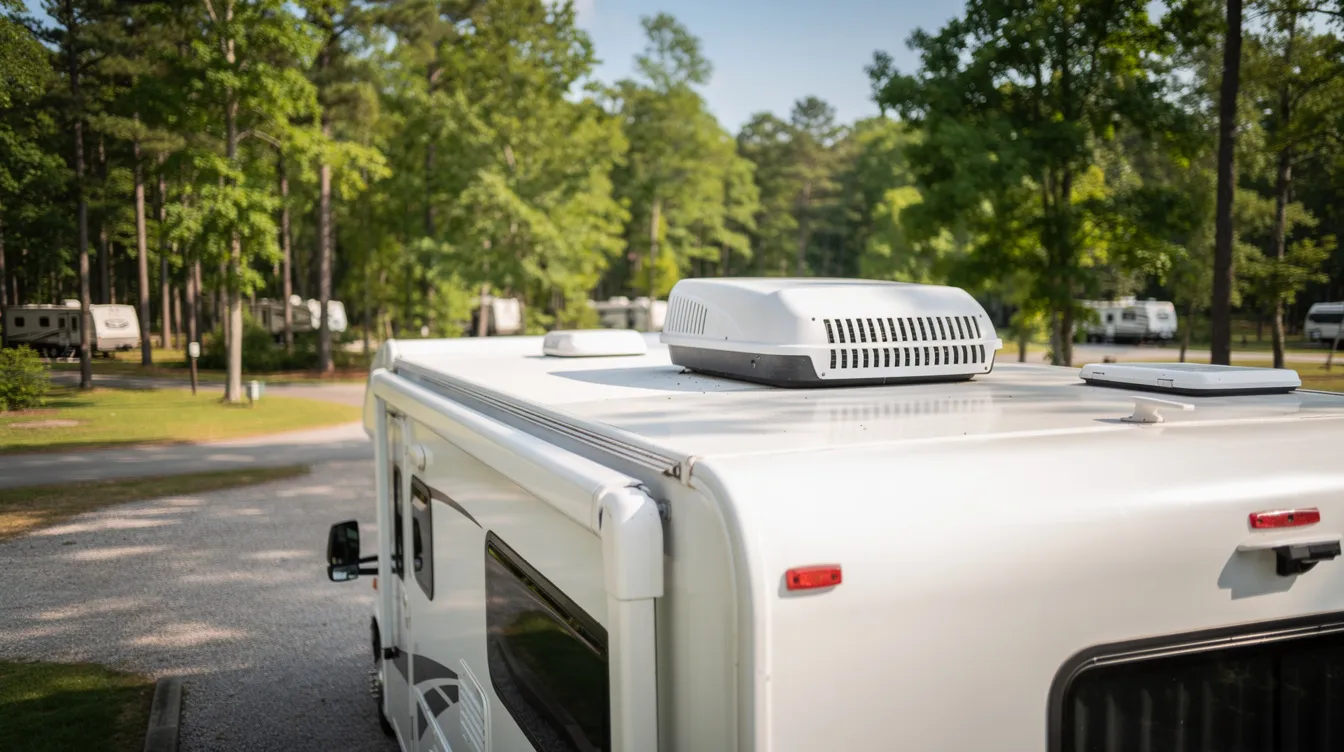
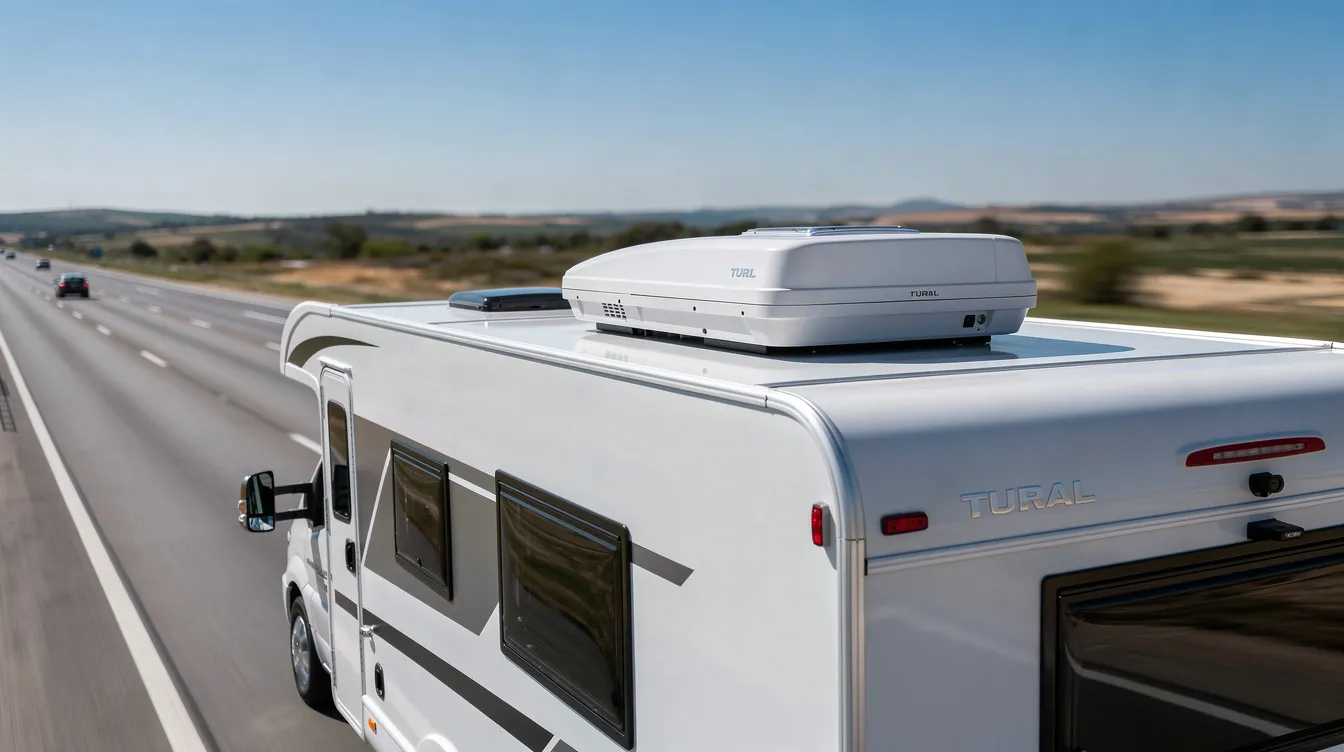
Rooftop air conditioners are standard for most rvs. They mount into a standard 14″ x 14″ roof opening and are designed for aerodynamic, low-profile performance while driving. Low-profile units reduce wind resistance and can improve fuel economy on long road trips. Aerodynamic low-profile designs reduce fuel consumption while driving, and some low-profile RV air conditioners operate as quietly as 43 decibels. Drainage management in RV air conditioning prevents leaks during operation through built-in condensate channels.
Under-bench or basement units mount below seating or in storage compartments, freeing roof space for solar panels or clearing low-clearance garages. Warm air from a heat cycle starts lower in the rig, which can feel more comfortable in cooler weather.
Portable air conditioners serve a different market: older rigs without rooftop cutouts, renters who cannot modify a roof, or supplemental spot cooling in extreme heat. Portable AC units like Coolzy weigh only 37 lbs. A Coolzy portable AC draws only 340 watts during operation, and Coolzy uses up to 80% less electricity than competitors. The trade-off is venting requirements, floor-space use, and less whole-rig cooling capacity.
General household window air conditioners are not always compatible with RV construction due to vibration, power, and space constraints.
Installation Basics: Roof Opening, Power, and Compatibility
DIY installs are common, but weight and structural compatibility are essential for rooftop AC installations. Most modern RV air conditioners fit a roof opening of approximately 14″ x 14″ (355 x 355 mm). Measure both the roof cutout and interior ceiling thickness before you buy.
RV air conditioners must manage strict power draw during operation. A 15,000 BTU AC can run on 30 amp shore power, but startup surge can trip breakers. Soft start kits can reduce startup current by up to 75%, allowing a single 15k unit to start on a smaller generator or inverter system. Efficiency is important for RV air conditioners used in off-grid scenarios with solar and battery banks.
High-level install steps:
Remove the old shroud and ceiling assembly.
Inspect and clean the roof opening; replace the gasket if worn.
Position the new unit, torque mounting bolts to manufacturer specs, and seal against leaks with appropriate sealant.
Reconnect or install ductwork (for ducted systems) and confirm the interior assembly covers the previous footprint.
Verify thermostat compatibility: wall thermostat vs. ceiling controls, analog vs. digital, and any needed adapter kits.
Features to Consider: Noise, Efficiency, Heat Pump & Controls
Noise levels are critical in RV air conditioning as units are located close to sleeping areas. Look for decibel ratings in product specs; many current units list 43-55 dB inside the rig at low fan speed. Compare quiet and sleep modes if the unit sits above your bed.
Inverter RV air conditioners with higher EER ratings are more energy efficient and friendlier to 30 amp hookups, smaller generators, and battery-inverter systems. Clean filters and coils are essential to maintain published efficiency numbers over the long run.
A heat pump adds electric heating for spring, fall, and mild winter trips in the South. In very hot climates (95-110°F), cooling-only models sometimes outperform similar heat pump units because of simpler refrigerant paths and fewer reversing-valve losses.
For controls, options include wall-mounted digital thermostats, Bluetooth or app control, and integration with multi-zone climate systems common in late-model fifth wheels and motorhomes. Choose controls that match your existing equipment to avoid rewiring.
Maintenance, Lifespan & Troubleshooting Common RV AC Issues
Routine care keeps summer trips comfortable and extends an RV air conditioner’s life. Most RV air conditioners last 10 to 15 years with proper maintenance.
Essential tasks:
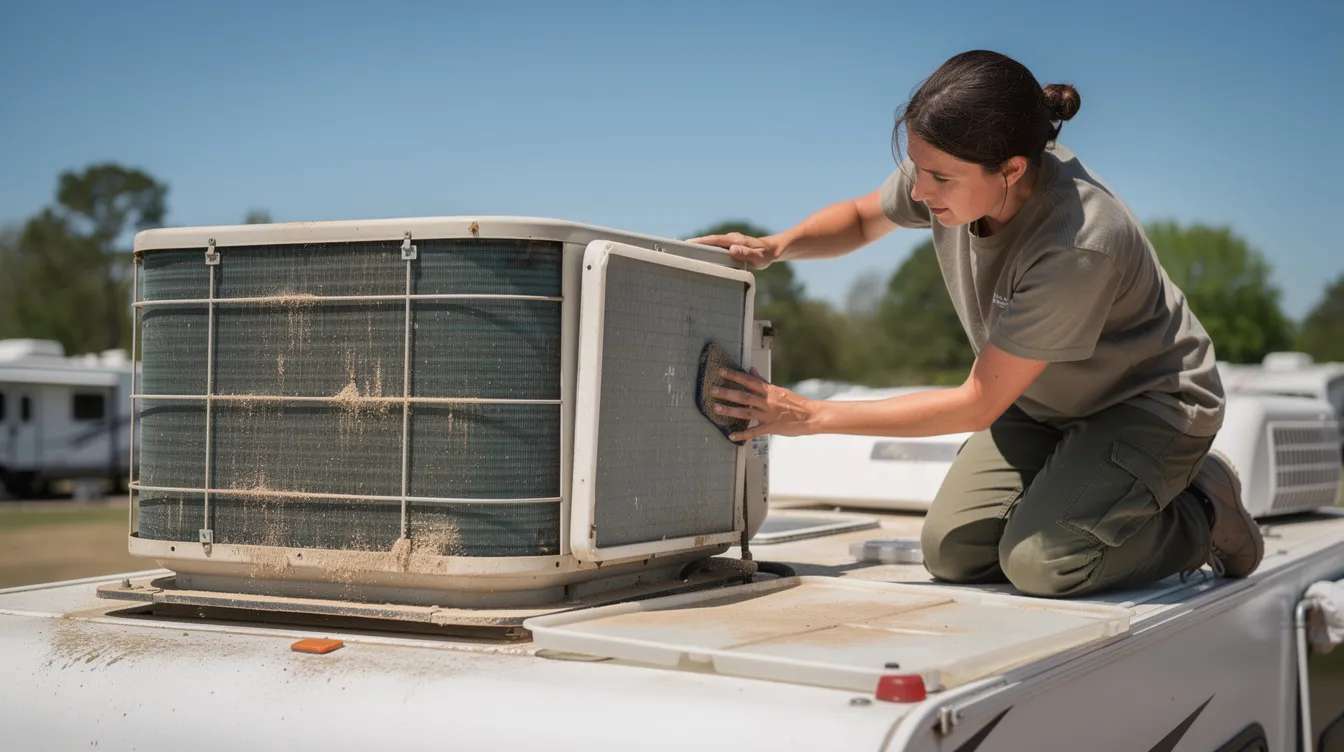
Clean or replace return-air filters every 2-4 weeks during heavy use.
Annual coil cleaning is essential for longevity; wash evaporator and condenser coils at least once per season.
Check roof gaskets and mounting bolts annually to prevent water leaks.
Common failure points include the capacitor and fan motor, typically at the 5-10 year mark. Control boards and thermostat issues also arise. The compressor itself is less likely to fail first.
Quick diagnostic checks:
Weak cooling: check the return air filter for clogs, inspect coils for ice, and confirm duct sealing on ducted systems. Measure the temperature drop between intake and output; 15-20°F after 10 minutes at max is the industry benchmark.
Unit won’t start: inspect breakers, confirm shore power voltage is above 110V, and test capacitors.
Water dripping inside: typically a blocked drain path or a compressed roof gasket.
Document your model and serial numbers before ordering parts; shroud covers, ceiling assemblies, and electronics are model-specific.
FAQ: RV Air Conditioners
Can I run my RV air conditioner while driving?
Most rigs cannot power a rooftop AC from the vehicle alternator alone. Options include running a generator, installing a DC kit tied to the alternator (rare), or relying on dash AC in smaller motorhomes. Class A and Class C motorhomes with onboard generators can run the rooftop unit on the road.
Will my RV AC run on solar and batteries alone?
A high-capacity lithium battery bank, a 3,000W+ inverter, and a soft start kit can power a 13,500 BTU unit for 1-2 hours on stored energy. Continuous all-day cooling requires 800-1,600W+ of solar panels and careful energy management. This is tested and achievable but demands a serious upfront investment in your electrical system.
Is a portable air conditioner a good permanent replacement for a rooftop unit?
Portables avoid roof work and store easily, but they require venting through a window or hatch, take floor space, and rarely cool a whole rig as well as a rooftop unit. For a single room in a small camper, a unit like the Coolzy (37 lbs, 340W draw) can work. For multi-room rigs or traveling in warmer climates, a rooftop replacement is the clear choice.
How do I know if I need a soft start kit?
If your breaker trips when the compressor kicks on, if lights dim at startup, if you run a 15,000 BTU unit on 30 amp service, or if you rely on a small inverter generator, a soft start kit will help. These kits reduce starting current by up to 75%, allowing the AC to start without overloading your power source.