Nobody plans for their camper’s cooling system to quit mid-road trip, but it happens – usually on the hottest day of the year, in a campground with no shade. Whether you own a travel trailer, fifth wheel, or motorhome, understanding camper ac repair costs, common failures, and basic troubleshooting can save you time, money, and a miserable night of sleep.
Key Takeaways
Most RV AC repairs cost between $150 and $1,200, while full rooftop unit replacement often runs $1,200–$3,500 installed.
Common camper air conditioning issues include poor cooling, water leaks, weak airflow, noisy operation, and musty smells – each with different likely parts and costs.
Simple fixes like a bad capacitor, fan motor replacement, or control board swap can usually be completed same-day by a mobile rv repair tech at your site.
It makes more sense to replace your rv air conditioner if it’s over 8–10 years old and the repair quote exceeds half the cost of a new unit.
Regular maintenance – filter changes, coil cleaning, shroud inspection, and roof gasket checks – helps your camper ac stay cool and avoid mid-summer breakdowns.
Average Camper & RV AC Repair Cost (Quick Answer)
Most RVs use rooftop air conditioners for cooling, and these specialized units cost more to service than the typical home ac. In 2026, most rv ac repair jobs fall between $150 and $1,200 depending on the problem, while full replacement with installation runs $1,200–$3,500.
Here’s how costs typically break down:
Low-cost fixes (thermostat swap, minor electrical, basic cleaning): $150–$350.
Mid-range repairs (capacitors, fan motor, control board, refrigerant leak repair): $300–$800.
Major repairs (compressor failure, severe electrical damage): $800+, where replacement often becomes the smarter move.
Service fees for RV repairs start at $125 for diagnostics, and hourly labor rates for rv ac repair can reach $175 or more during peak summer demand. Mobile rv repair services may add a trip fee of $0–$95 on top of labor and parts. Professional RV AC service requires specialized knowledge beyond standard HVAC, which is why pricing runs higher than rv owners typically expect.
Common Camper AC Problems and What They Usually Cost
Below is a practical breakdown of the symptoms you’ll notice and what each typically costs to fix.
No Power. If the ac unit appears completely dead, check for a tripped campground pedestal breaker, faulty 30A/50A rv breaker, or loose wiring. Low voltage can cause rv air conditioners to struggle and not function properly. Simple electrical fixes run $150–$300; a new control board installed pushes costs to $300–$600.
Blowing Warm Air. When the unit runs but only pushes warm air, common culprits include a bad capacitor, dirty condenser coils, or low refrigerant from a leak. Low refrigerant usually indicates a leak in the system, not just a need for a top-off. Expect $200–$400 for a capacitor and tune-up, $400–$900 for refrigerant leak repair and recharge, or $900+ if the compressor is failing.
Weak or No Airflow. Restricted airflow often leads to frozen evaporator coils in rv air conditioners. Weak airflow can indicate clogged filters or blocked ducts in ducted systems. Cleaning and filter work runs $150–$300; fan motor parts and labor cost $300–$600.
Water Leaks and Dripping Inside the Camper. Water leaks inside RVs can be caused by clogged condensate drains or damaged gaskets. Clearing drains and resealing runs $150–$350; full gasket replacement pushes to $300–$600+.
Noisy or Musty-Smelling RV AC. A musty smell from the ac usually means dirty components – mold on coils and standing water in the drain pan. Noise often points to loose fan blades or worn fan motor bearings. Cleaning and tightening costs $150–$350; fan motor replacement runs $300–$600. Loud compressor sounds suggest deeper issues where replacement may make more sense.
DIY Troubleshooting for Camper AC Issues (Before You Call for Help)
Before booking a professional service, try these steps yourself. Cleaning the air filter is a common troubleshooting step for rv ac issues and often solves the problem entirely.
Electrical and thermostat checks. Verify your shore power or generator output. Reset the breaker on the power pedestal and confirm the main rv breaker isn’t tripped. Frequent circuit breaker trips may indicate electrical overload or failing capacitors – note this pattern for your technician. Check your thermostat mode (Cool vs. Fan), temperature setpoint, and replace batteries if applicable.
Simple airflow fixes. Remove and inspect the return air filter inside the camper. Clean or replace it as needed. Open every supply vent and verify nothing is blocking the intake or discharge. Clogged filters force the ac to work harder, increasing wear on internal components.
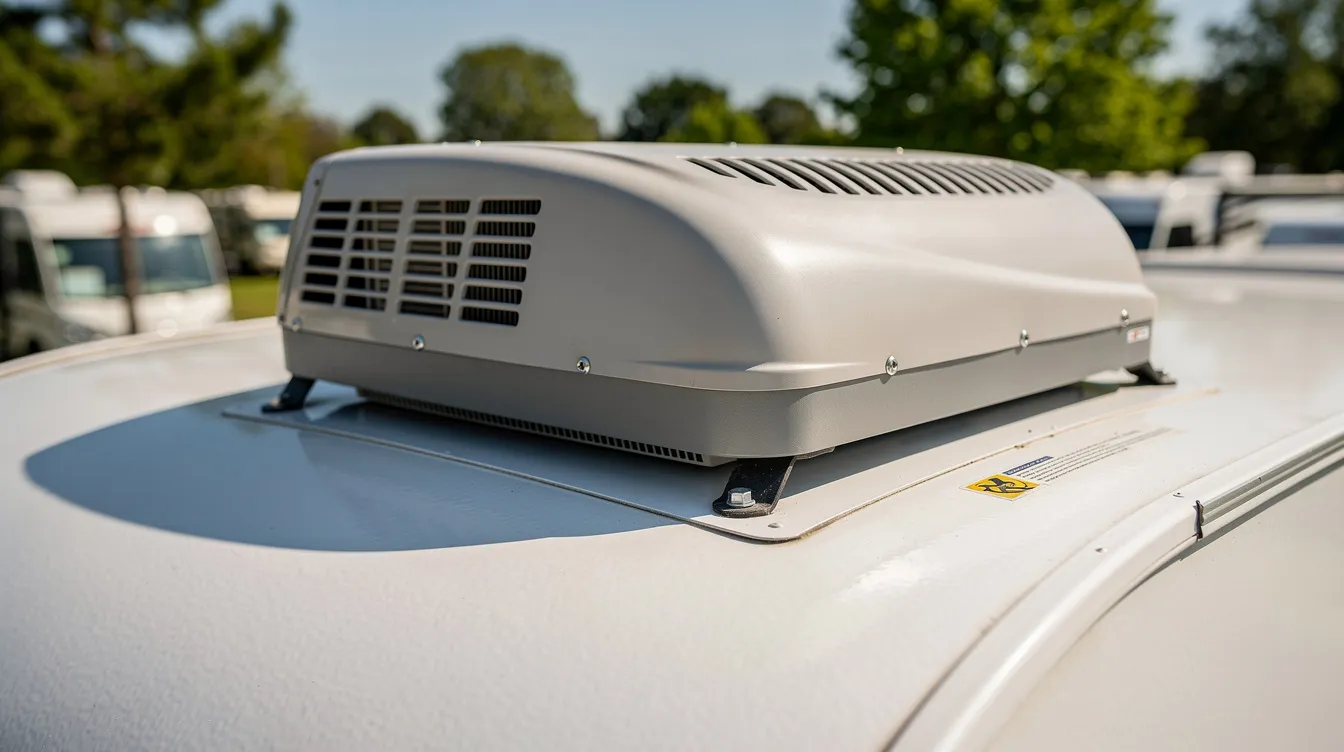
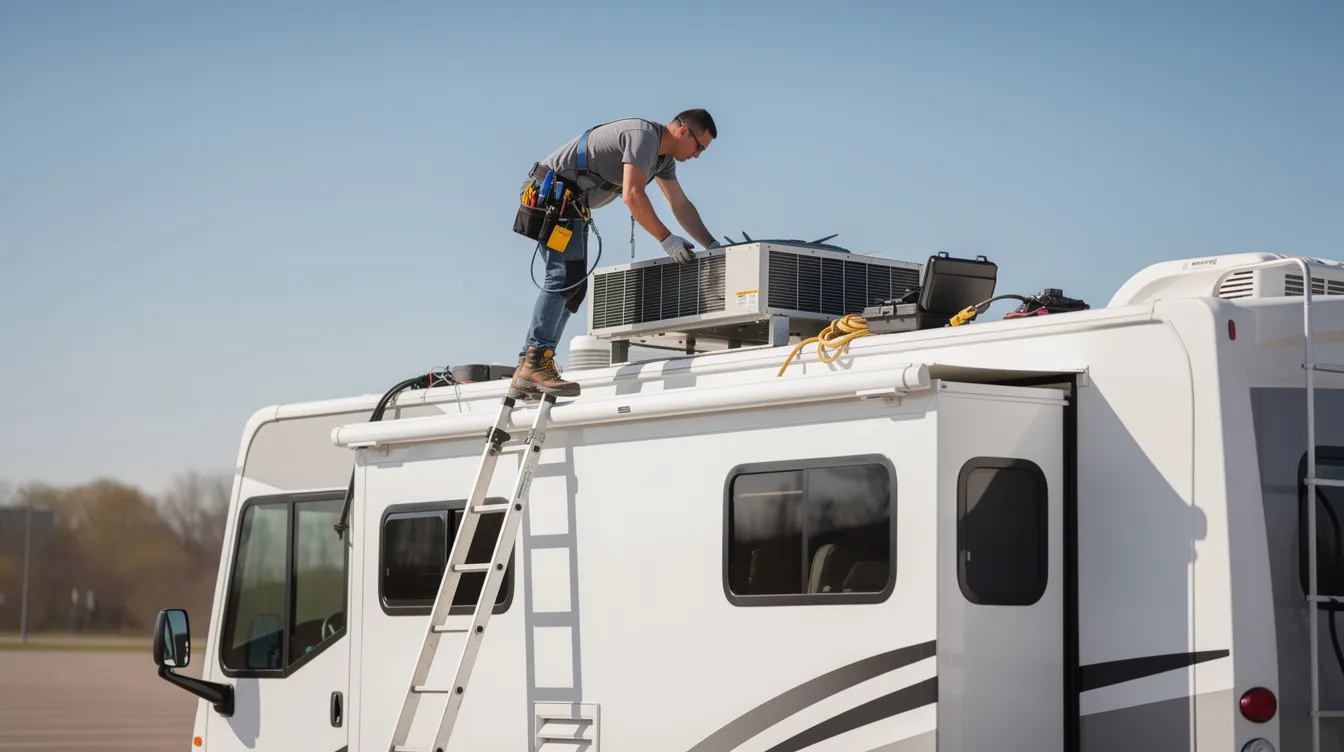
Initial rooftop checks. Turn off 120V power at the breaker, then carefully climb onto the roof on a dry day. Remove the shroud and visually inspect for heavy dirt on coils, ice buildup, or obvious loose wires. Inspecting rooftop units can help identify blocked condenser coils and debris. Never attempt refrigerant work as DIY.
Odor and moisture checks. Look for standing water in the drain pan, mold on plastic trim, and water staining around the roof opening. Clean grilles with a mild cleaner and let everything fully dry.
If your breaker trips repeatedly, you smell burning, see melted wiring, or the fan motor hums but won’t spin, shut the ac unit off immediately and call for rv ac repair. These are not DIY problems.
Repair or Replace? When a New RV Air Conditioner Makes More Sense
Many rooftop rv ac units on the road in 2026 are 2012–2016 models nearing end of life. Air conditioners over 10 years old often require replacement rather than continued repair. RV rooftop units typically last 10–15 years with regular maintenance, but frequent use in hot climates like Texas, Arizona, or Florida effectively shortens that window.
The 50% rule. If a single repair quote exceeds 50% of what a comparable new unit would cost installed, replacement usually makes more financial sense. For example, a $1,000 repair estimate versus $1,800 for a new 15k BTU unit tips the scale toward a new unit. Compressor replacement often costs as much as a new unit, making it the clearest trigger for this decision.
Replacement cost ranges. New 13.5k–15k BTU rooftop rv air conditioner units, including labor and roof gasket work, generally cost $1,200–$3,500. Brands like Coleman Mach and others offer models with ducted or non-ducted configurations, heat pump options, and soft-start technology.
Newer models cool faster, draw fewer amps on 30-amp hookups, and run significantly quieter. Soft-start technology reduces startup surges, making generator or small park pedestal use more reliable. Have experienced technicians handle the rooftop removal, sealing, and wiring into your existing control board and thermostat to avoid roof leaks and electrical hazards.
Inside the Camper AC: Key Parts That Commonly Fail
Understanding what’s inside your ac unit helps you make informed decisions and follow along when technicians explain the diagnosis.
Compressor. The compressor pumps refrigerant through the cooling system’s high and low sides. Compressor failure is the costliest repair – the unit may try to start, trip breakers, or run while only blowing warm air despite clean filters and good fan operation.
Fan motor. Rooftop rv units typically use a single dual-shaft fan motor to spin both the indoor blower and the outdoor condenser fan. Symptoms of failure include squealing, grinding, slow fan speeds, or a hum without rotation. This is a mid-range repair, not a minor one.
Capacitors. Start and run capacitors help the compressor and fan motor start and stay running. Replacing a start capacitor is often required if the air conditioner hums but does not start – capacitor failure accounts for 30–40% of all summer AC service calls. It’s typically an affordable fix.
Control board and thermostat. The control board interprets thermostat signals and manages compressor and fan timing. Erratic cycling, the unit not responding to temperature changes, or random shut-offs may point to board or thermostat issues.
Coils, filters, and ductwork. Dirty evaporator or condenser coils and neglected filters restrict rv air and force the system to work harder, shortening compressor and fan motor life. Ducted rv air systems can hide crushed or disconnected ducts that cause room-to-room temperature swings in motorhomes and fifth wheels.
Preventive Maintenance to Keep Your Camper AC Blowing Cold
Regular maintenance extends your rv ac lifespan and helps you avoid costlier repairs down the line.
Filter care. Clean filters improve rv ac performance significantly. Clean or replace interior ac filters at least once a month during heavy summer use, and always before a long road trip. This is one of the simplest ways to stay cool and reduce strain on the fan motor and compressor.
Coil and shroud cleaning. Inspect the rooftop ac shroud twice a year for cracks and UV damage. Advise gentle coil cleaning with a soft brush or RV-safe cleaner to remove dust, bugs, and pollen that cause the unit to run hot and blow warm air. Dirty coils can reduce heat rejection efficiency by 15–25%.
Gasket and leak checks. Check the foam or rubber roof gasket around the ac base annually for compression, cracking, or gaps. Loose mounting bolts or a flattened gasket allow rainwater into the camper – and resealing is far less expensive than repairing water damage.
Operational best practices. Start the air conditioner early in the day rather than waiting for extreme interior heat. Use awnings, window shades, and shade parking to reduce roof temperature and lower ac run time. Running the ac for 15 minutes monthly – even in cooler weather – maintains optimal condition.
Yearly professional service. Schedule an annual rv ac service appointment in early spring. Certified technicians can run full electrical checks, test capacitors, clean coils, and inspect the roof – catching problems before peak-season failures. In hot-climate markets, providers like RV Repair Hero’s Tucson mobile RV service help you avoid costly emergency repairs during summer.
When to Call Mobile RV Repair and What to Expect
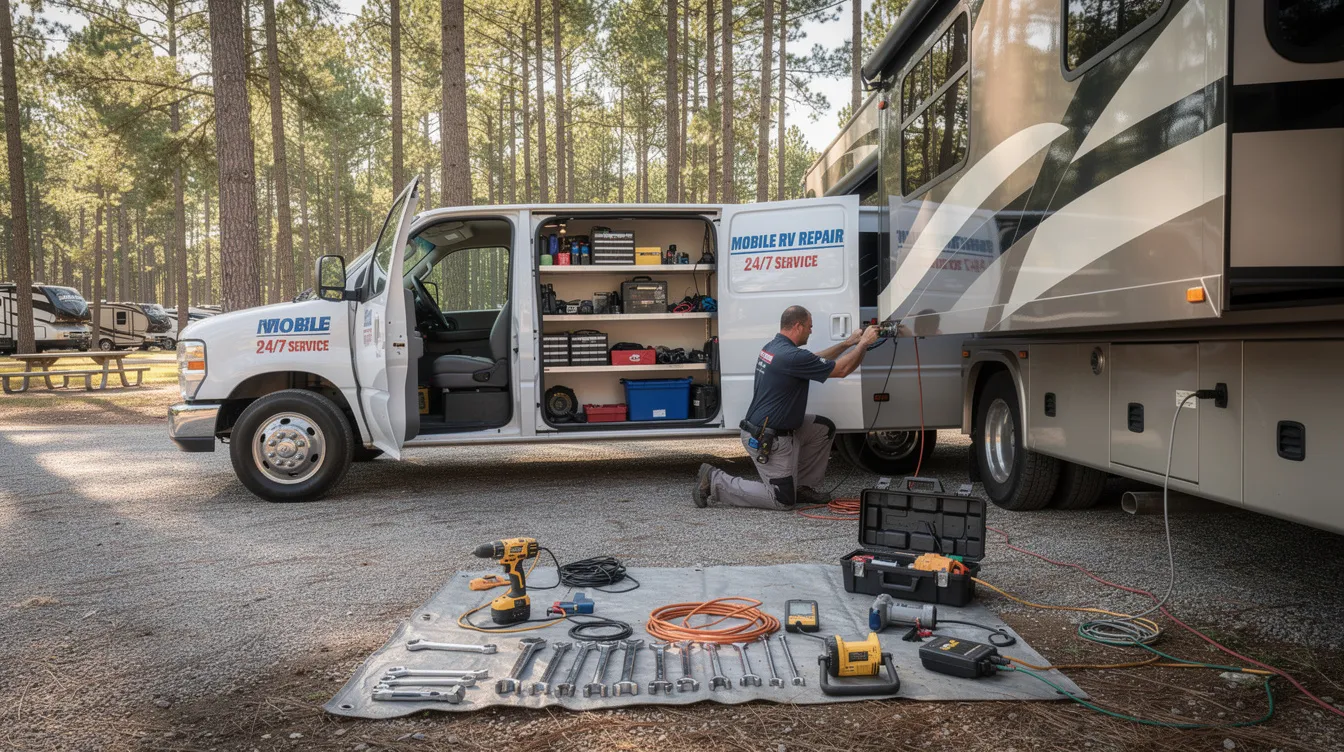
Mobile rv ac repair services come directly to your location – whether your camper is set up at a campground, in storage, or in your driveway. Services like RV Repair Hero’s mobile RV repair in Tucson, AZ can diagnose issues on-site without towing, which is exactly what you need when your ac goes out mid-trip.
Call now if you notice: persistent breaker tripping when the ac starts; burning or electrical smells, visible sparks, or melted wiring; a fan motor that hums but won’t spin after basic checks; or water actively leaking from the ceiling around the ac interior trim.
What a typical visit includes. Technicians understand these systems inside and out. Expect an initial discussion of symptoms, followed by systematic testing of power supply, thermostat, capacitors, fan motor, control board, and refrigerant pressures. They’ll also visually inspect the rooftop unit, shroud, coils, and roof gasket. Professional service ensures proper refrigerant handling according to EPA regulations.
Fee structure. Most mobile rv repair services use a flat service or trip fee plus an hourly labor rate, with parts priced separately. Local options such as RV Repair Hero in Marana, AZ emphasize transparent pricing, explain repair options clearly, and get your approval before proceeding. Quality workmanship means the technician will walk you through next steps and help you diagnose whether to fix or replace.
How to prepare. Clear space around the interior ac assembly, ensure safe roof access if possible, and have your ac make/model, recent repair records, and campground power details ready.
Timelines. Many issues like bad capacitors, fan motors, and control boards can be fixed same-day if parts are on the truck. Full ac unit replacement may require scheduling once the correct model is sourced for your specific installation.
Camper AC Repair FAQ
Can I run both of my RV AC units on a 30-amp hookup?
Generally, no. A 30-amp hookup provides roughly 3,600 watts, and most rooftop ac units draw 12–16 amps each at full load. Running two simultaneously plus other appliances will overload the circuit. A soft-start device can reduce startup surge but won’t change continuous draw enough to safely run both units plus normal loads on 30 amps.
Is it okay to run my roof AC while driving my motorhome?
Many motorhomes run the rooftop ac while driving with the onboard generator. For towable campers like travel trailers and fifth wheels, you’ll rely on the tow vehicle’s ac until you’re parked and plugged into shore power or running a generator on site.
Do I need to cover my camper’s rooftop air conditioner in winter?
Covers protect against debris and weather damage, but they can also trap moisture and attract pests if not properly ventilated. A better approach is to keep the roof clear of debris, do a thorough pre-season inspection in spring, and address any shroud cracks or gasket issues before your first warm-weather trip.
Can my RV AC just be “topped off” with refrigerant if it’s low?
No. RV rooftop units are factory-sealed, so low refrigerant indicates a leak in the system. Simply recharging without finding and repairing the leak is temporary, wasteful, and may violate environmental regulations. Always have certified technicians locate and fix the leak first, then recharge to the correct level.