Nothing ruins a summer road trip faster than an RV air conditioner that stops cooling. If your Furrion Chill is throwing error codes, blowing warm air, or refusing to start, this guide walks you through practical, step-by-step furrion chill troubleshooting so you can diagnose the issue and decide whether it’s a quick fix or a call to a technician.
Key Takeaways
This is a hands-on troubleshooting guide for Furrion Chill and Furrion Chill Cube rooftop RV AC units manufactured after about 2019. Many steps also apply to other modern RV air conditioners.
The most common issues are error codes (E1, E2, E3), blowing warm air, the unit not turning on, evaporator coils freezing up, and the fan running with no cooling.
Many problems trace to power supply issues, control box communication faults, sensor failures, airflow restrictions, or installation mistakes-not a failed compressor.
Common issues with RV air conditioners include performance problems and maintenance difficulties, and improper installation or maintenance can lead to significant cooling issues.
Always disconnect 120V shore power and 12V battery power before opening the AC unit or control box. Call a certified RV technician if you’re uncomfortable working around electricity or on the roof.
This guide explains what Furrion error codes mean, how to diagnose warm air and low cooling performance, and when replacement parts like a control box or thermostat are likely needed.
How the Furrion Chill RV Air Conditioner Works (Quick Overview)
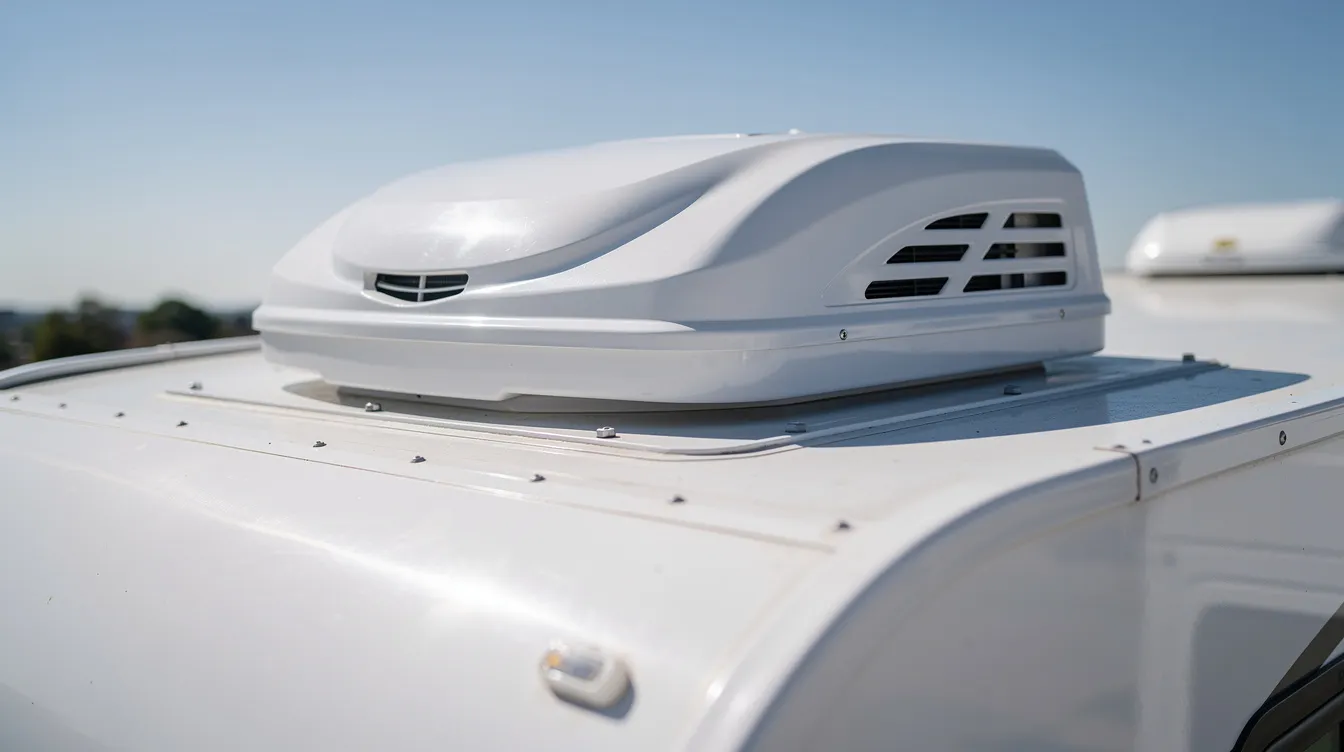
A Furrion Chill rooftop RV air conditioner works like most modern AC systems. The compressor pressurizes refrigerant, which carries heat from the indoor evaporator coil to the outdoor condenser coil. A fan blows interior air across the cold evaporator, and a separate condenser fan dissipates heat outside. The control box and wall thermostat coordinate everything-when to start the compressor, what fan speed to run, and when to cycle off. Furrion ACs can have up to 50% greater cooling capacity than competitors, especially in the Cube line with its variable-speed compressor.
Key Furrion models to know:
Standard Furrion Chill and Chill HE: fixed-speed units rated at 13,500–15,500 BTU, common on mid-size and large rigs. The HE (High Efficiency) line uses dual-fan designs and enhanced shrouding for quieter, more efficient operation.
Furrion Chill Cube: compact, variable-speed compressor units (up to 18,000 BTU), popular on smaller rigs or in paired installations. These draw lower startup amps-often under 5 amps-making them more generator and inverter friendly.
The wall thermostat communicates with the rooftop control box via low-voltage A/B communication wires (RS-485 protocol). The control box then switches 120V power to the compressor and fan motors. Main components are located as follows: thermostat inside the living space, control box in the ceiling assembly under the shroud, and the compressor and coils mounted on the roof.
Understanding this basic system helps when interpreting symptoms like warm air, short cycling, or specific error code patterns.
Safety First: Power, Access and Tools
Working on an RV AC unit means dealing with 120V AC power capable of serious injury, 12V DC circuits, and potentially spinning fan blades. Roof work adds fall risk. Take this seriously.
Before you gain access to any part of the AC system:
Unplug shore power from the pedestal
Shut down the generator
Switch off the inverter
Disconnect or turn off the RV’s house battery disconnect switch
Wear insulated gloves, safety glasses, and non-slip shoes if climbing on the roof. Use a stable ladder rated for your weight.
Gather these tools before starting-they’ll be referenced throughout this guide:
Digital multimeter and non-contact voltage tester (test light)
#2 Phillips and square-drive screwdrivers
Nut drivers and basic socket set
Flashlight and probe thermometer
Do not open the sealed refrigeration circuit or attempt to recharge refrigerant. This requires EPA-certified HVAC/R or RV technicians with proper recovery equipment.
Decoding Furrion Chill Error Codes
The Furrion Chill control system displays error codes on the wall thermostat or display panel to flag specific faults. Actual codes can differ slightly by production year and firmware, so always cross-check with your specific owner’s manual. That said, the core codes have remained consistent since about 2020.
Here are the most common Furrion Chill error codes:
E1 – Indoor temperature sensor failure. Furrion AC error code E1 indicates indoor temperature sensor failure, and the system generally shuts down.
E2 – Evaporator or freeze sensor fault (open or shorted thermistor). Evaporator sensor failure indicates an open circuit in the sensor.
E3 – Loss of communication between control box and thermostat (A/B wire issue). E3 indicates loss of communication between control box and thermostat.
E4 – Condenser temperature sensor failure (less common, sometimes triggered by mis-set dip switch settings).
E5 – Outdoor temperature sensor failure. Outdoor sensor failure causes the entire system to shut down.
Lo / L0 – Low DC voltage error occurs when DC voltage drops below 10 volts at the control electronics.
Note that not every Furrion air conditioner or control panel displays codes identically. Some older RV AC installations use aftermarket thermostats where codes may not match Furrion’s standard list. The next sections explain each of the most frequent codes and what they mean in practice.
Fixing Common Furrion Chill Error Codes
This section walks through each error code with likely causes and home-level fixes before recommending part replacement.
E1 – Indoor temperature sensor failure. Symptoms include the thermostat reading way off from actual room temperature, or the unit short cycling and refusing to start. Thermostat sensor placement can impact the cooling system’s performance-on some models the sensor sits in the return-air area of the control box, on others it’s integrated into the thermostat. If the sensor is embedded in the rooftop control box wiring harness, you often need to replace the entire control box as a unit. Check connectors for corrosion or a disconnected wire first.
E2 – Evaporator / freeze sensor failure. This usually means an open or shorted thermistor clipped onto the evaporator coil. Inspect the connector for loose or corroded pins and ensure the probe is securely attached to the copper line on the coil. If wiring looks intact but the code persists, replace the sensor probe. This sensor prevents the coils from freezing and blocking airflow entirely.
E4/E5 – Condenser or outdoor sensor faults. These are less common on cool-only Furrion Chill units. They can occasionally be triggered if a heat pump dip switch is accidentally set on a cool-only unit. Correcting dip switch settings and power-cycling often clears the error without any part replacement.
E3 – Loss of communication. Verify the A and B communication wires are landed on the same labeled terminals at both the thermostat and control box ends. Look for pinched, reversed, or damaged cable along the run, and reseat plug connectors in the ceiling assembly. Many RVers find this code appears after rodent damage or a loose connector vibrated free during travel.
Lo / Low voltage warnings. Check house battery voltage at rest-aim for 12.2–12.8V. Inspect the battery disconnect switch, fuses in the DC fuse panel, and converter/charger output, especially when connected to shore power. A weak or disconnected battery can trigger this code even with 120V present.
If an error code returns immediately after a power reset and basic checks, the most likely culprits are a failed sensor, a bad thermostat, or a defective rooftop control box. Match part numbers to the Furrion documentation for your specific BTU rating and model year before ordering a replacement.
When Your Furrion Chill Blows Warm Air or Doesn’t Cool
The classic complaint: the RV AC fan runs but only room-temperature or slightly warm air comes from the ceiling vents, even when the thermostat is set well below ambient temperature.
Start with a 15-minute performance test: close all doors and windows, run the Furrion Chill or Furrion Chill Cube on cool and high fan for at least 15 minutes, then measure return-air temperature versus supply-air temperature directly at the vents. Under normal 80–90°F outdoor conditions, you should see approximately a 16–22°F temperature drop. If return air is 80°F, supply air should read roughly 58–64°F.
Before assuming the worst, check the basics:
Thermostat settings should be adjusted to ensure proper cooling operation. Verify you’re in cool mode, not fan only or heat mode. Set the temperature at least 5°F below current room temperature to trigger the compressor.
If the compressor never starts-no change in sound, no increased current draw-the issue is likely in the control box, run capacitor, or compressor circuit. This usually requires technician-level diagnosis with an ammeter.
Inspecting ductwork for blockages can improve airflow to the vents. In ducted installations, loose foam dividers, collapsed duct runs, or misaligned ceiling assemblies can mix warm return air with cooled supply air, making vents feel lukewarm even when the AC unit itself produces cold air.
Improperly sized AC units can lead to freezing issues-and on a large, poorly insulated rig in full sun, a single 13.5k BTU unit may simply not have enough capacity. Adding reflectix shades, awnings, or a second rooftop RV AC unit may be necessary in hot climates.
Basic Checks Before You Climb on the Roof
Start with easy, ground-level inspections that solve a surprising percentage of Furrion Chill complaints without ever removing the shroud.
120V AC breakers: Check all breakers in the RV’s main panel, including any dedicated breaker labeled “AC” or “Air Conditioner.” Reset tripped breakers by fully switching them off, then back on.
12V DC supply: Ensure the main battery disconnect is on. Inspect the fuse that feeds the thermostat and control box-usually in the RV’s DC fuse panel. Confirm interior 12V lights and the fan work normally.
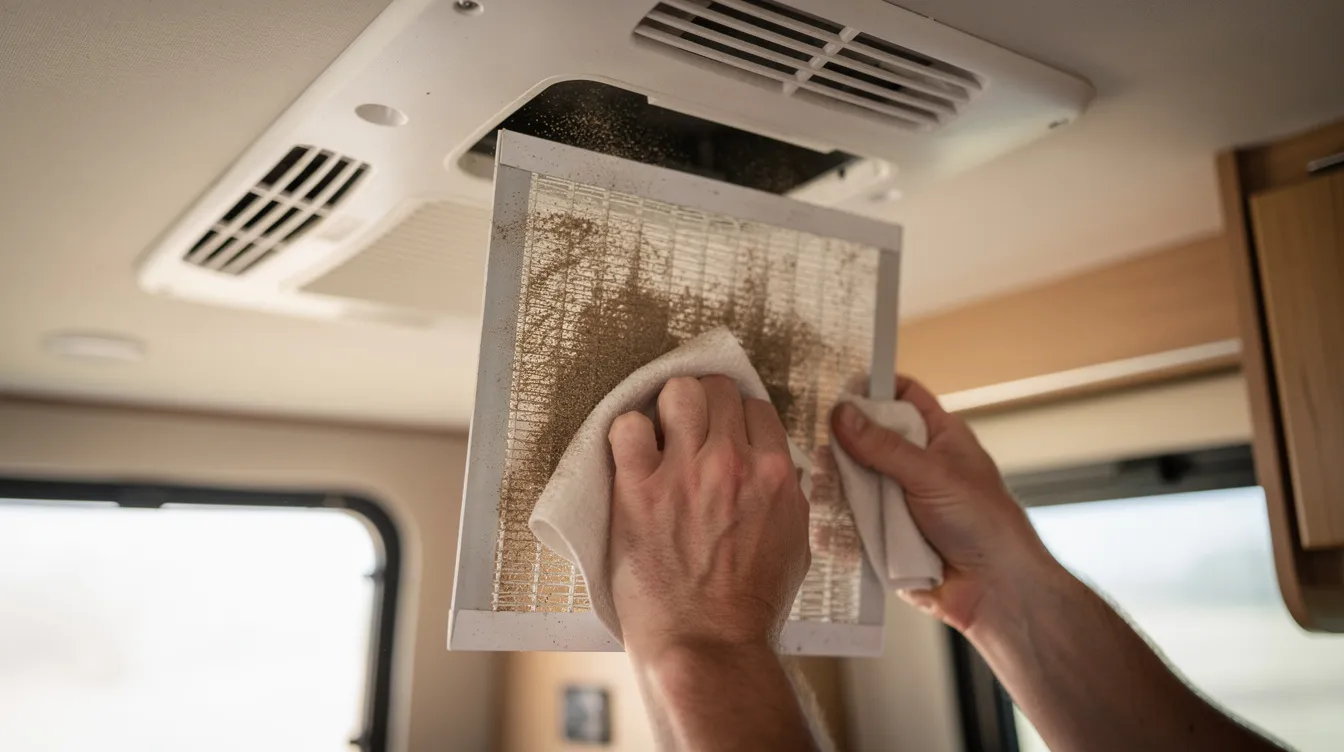
Air filters: Inspect air filters monthly and replace if dirty. A dirty air filter can cause RV AC freeze-ups and warm air complaints. Remove the Furrion ceiling return filter, clean with mild soap and water, and dry fully before reinstalling. Dirty air filters restrict airflow and can cause freezing.
Supply vents: Open all supply vents, especially on ducted systems. Partially closed vents in bedrooms and slide-outs can create the impression the AC unit is weak. Blocked return air paths can restrict airflow and cause cooling inefficiencies.
Plenum obstructions: Verify that no large furniture, foam blocks, or aftermarket sound baffles are obstructing the interior plenum where return and supply paths separate.
Roof-Level Inspection and Airflow Troubleshooting
Once power is disconnected and ground-level checks are complete, a rooftop inspection of the Furrion Chill housing and airflow paths comes next. Proper airflow through both coils is non-negotiable for cooling performance.
Remove the shroud: The Furrion Chill plastic shroud typically has several perimeter screws. Pull it off gently and inspect the condenser coil fins for dirt, leaves, cottonwood fluff, or bent fins that restrict airflow. Inspecting rooftop coils for dust and debris is essential for optimal system efficiency.
Clean both coils: Clean evaporator and condenser coils monthly during heavy use seasons. Use a soft brush, compressed air, and coil-safe cleaner, avoiding bending delicate fins. Dirty evaporator coils can cause AC freeze-ups. Inspect coils for damage to maintain efficiency.
Foam baffles and dividers: The foam baffle between return and supply air in the rooftop assembly must be intact and properly seated. If it’s misaligned, cracked, or missing, cold supply air recirculates directly into the return path, making the unit cycle on artificially cold air and shut down prematurely.
Roof gasket: Inspect the gasket between the AC base and the RV roof. Air leaks in the system can cause efficiency losses and operational problems. If the gasket is crushed, cracked, or has gaps, outside warm air gets drawn into the return, and moisture or water can start leaking into the ceiling. Retorquing the four mounting bolts or replacing the gasket and seal may be needed after a few years.
External obstructions: High winds, blocked rooftop vents, or nearby accessories (solar panels, cargo boxes) too close to the shroud can disrupt condenser airflow and reduce performance. Check for leaks in the AC system regularly while you’re up there.
Checking the Furrion Control Box and Thermostat Wiring
The rooftop control box is the “brain” of Furrion air conditioners, controlling the compressor, fan speeds, and communication with the interior thermostat controller.
To access the control box, remove the interior ceiling assembly cover under the Furrion Chill unit. This exposes the low-voltage wiring harness connections and high-voltage terminal block.
A/B communication cable: Each wire must land on the same labeled terminal at both the thermostat and control box. Swapped or loose wires cause E3 communication errors, intermittent operation, or no response to thermostat commands.
120V AC verification: Using a multimeter, confirm 120V AC is present at the control box input when breakers are on. Only do this if you’re confident and experienced around live circuits. Absence of power points back to wiring, breakers, or transfer switch issues rather than the AC unit itself.
Burn marks or damage: Charred insulation, melted terminals, or burn marks inside the control box are signs to immediately stop DIY work and consult a technician. These usually indicate short circuits or failing components that can cause fire risk.
Replacement: If wiring checks out but the AC still will not start, replacing the control box with an exact-match Furrion service part is often the next logical step. Document model and serial data from the rooftop data plate before ordering.
Preventing Freeze-Ups and Ice on the Furrion Chill Coils
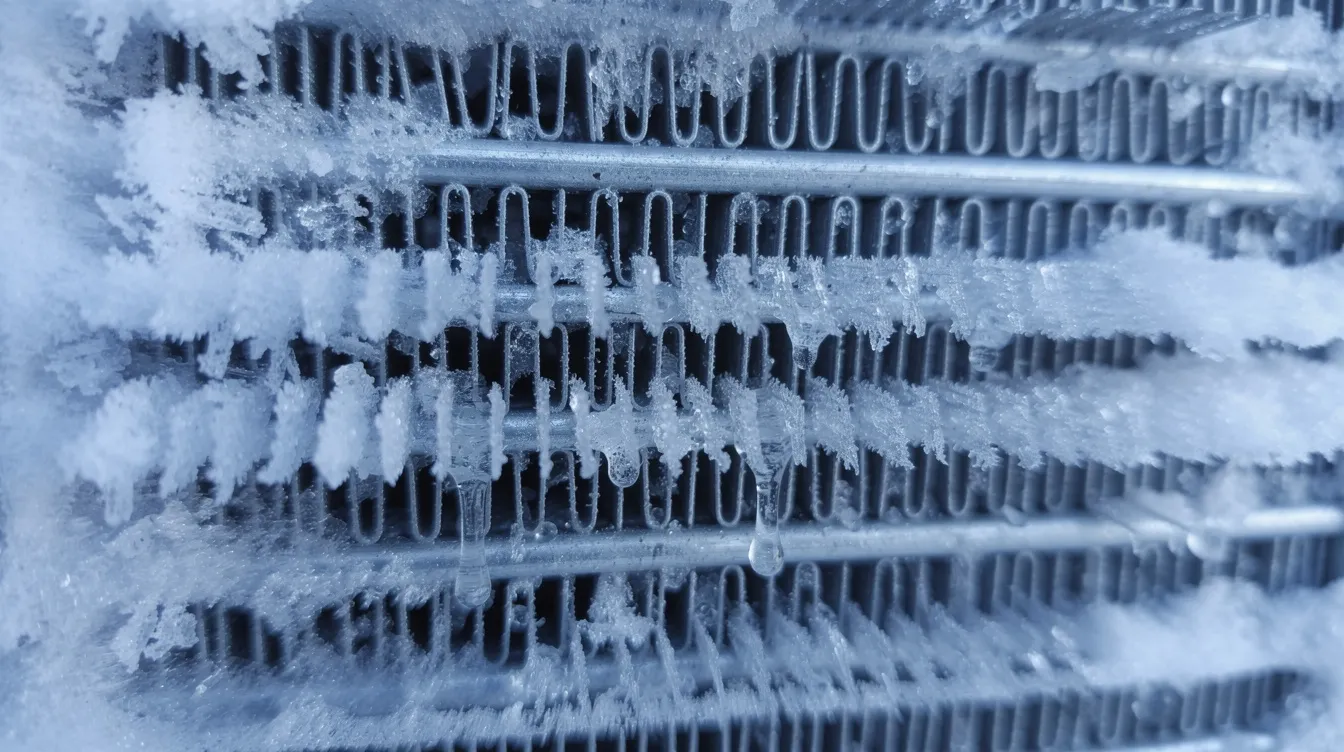
“Freezing up” means ice forming on the evaporator coil or inside the plenum, resulting in rapidly weakening airflow and eventually only warm air or complete blockage. Maintaining proper airflow is critical to prevent freezing of evaporator coils.
Key causes of freeze-ups:
Dirty filters and dirty evaporator coils-the most common culprits. Ensure proper airflow to prevent AC freeze-ups by keeping filters clean.
Low fan speed in high humidity environments. High humidity can overload an AC unit, causing freeze-ups.
Blocked return-air paths from furniture, closed vents, or collapsed ducts.
A faulty evaporator sensor (E2) that fails to shut the compressor down when the coil temperature drops to freezing conditions.
Low refrigerant levels can lead to AC freezing-this is a sealed-system issue that requires professional service.
Simple defrost process: Turn the AC to fan only with the compressor off, open vents or windows if needed, and let the fan run 30–60 minutes until all ice melts. Do not chip ice off with tools-you’ll damage the fins.
Chronic freezing in a relatively new Furrion air conditioner with clean filters and coils can indicate low refrigerant charge from a leak or duct design issues specific to certain RV models. Routine inspections of rooftop coils and ductwork enhance the performance of RV air conditioners and catch these problems early.
Power and Voltage Issues Affecting Furrion Air Conditioners
Both 120V AC supply and 12V DC control power must be healthy for a Furrion Chill or Furrion Chill Cube to start, run, and cycle properly. Rooftop air conditioners typically require stable voltage to operate effectively.
120V problems: Low campground voltage during peak summer afternoons, undersized extension cords, or overloaded RV power systems can cause the compressor to try starting and then trip the breaker. The Chill Cube draws about 1,330W running (roughly 12–14 amps at 115V), but even with its low startup load of under 5 amps, voltage sag can still cause failure.
Voltage monitoring: Use a plug-in voltage monitor at the RV pedestal. Aim for 108–132V at the AC inlet. Shut down the RV AC if voltage drops below about 105V to avoid compressor damage.
12V DC issues: Weak batteries, corroded battery connections, or failing converters can drop control voltage below Furrion’s requirements, triggering low-voltage error codes or random shutoffs even when 120V shore power appears normal. Low voltage error occurs when DC voltage drops below 10 volts.
Aftermarket equipment: Soft-start modules, inverter-charger systems, and auto load-shedding energy management systems can affect how and when Furrion air conditioners start. Document any added equipment when troubleshooting intermittent problems.
When to Call a Professional RV Technician
While many furrion chill troubleshooting steps are owner-friendly, some repairs are better left to certified RV or HVAC technicians to protect safety and preserve warranty coverage. RVers near Tucson can benefit from a mobile RV repair service in Tucson, AZ that comes directly to your campsite or storage location for diagnostics and repairs.
Call a professional when you encounter:
Persistent error codes that return after resets and wiring checks
Visible refrigerant oil or hissing sounds indicating leaking refrigerant
Loud grinding or metal-on-metal noises from the compressor or fan-rattling noises in air conditioners can indicate loose mounting bolts or mechanical issues
Repeated breaker trips when the AC tries to start
If you need on-site help in southern Arizona, a mobile RV repair service in Marana, AZ can inspect your Furrion system, perform diagnostics, and handle roof or electrical repairs without a trip to the shop.
Sealed-system work (refrigerant diagnosis and charging), compressor replacement, and complex duct modifications should always be handled by trained professionals. Before calling, gather your RV year and model, specific Furrion Chill or Chill Cube model number, description of symptoms, and whether issues occur on shore power, generator, or both.
Regular maintenance helps prevent RV air conditioner issues and includes cleaning filters. An annual professional inspection-cleaning coils, checking capacitors, inspecting the control box, and verifying amp draw-can greatly extend the life of your Furrion RV air conditioner and reduce surprise failure during peak travel months.
FAQ
These FAQs cover edge cases and ownership questions not fully addressed above. Each answer references Furrion Chill and Furrion Chill Cube models where relevant.
How cold should the air be coming out of my Furrion Chill vents?
Rather than targeting a specific vent temperature, measure the difference between return air and supply air after 15–20 minutes of runtime. A healthy Furrion Chill should produce a 16–22°F (about 9–12°C) drop. For example, if your RV’s return air reads 80°F, supply air at the vent should be roughly 58–64°F. Very high humidity or extreme outdoor heat above 95°F can narrow this split slightly, which is normal.
Can I run two Furrion Chill AC units on a 30-amp RV hookup?
Many 30-amp RVs are wired for only one air conditioner, though some newer models come prepped for a second unit. Running two full-size rooftop RV air conditioners typically requires 50-amp service unless soft-start kits, energy management systems, or load-shedding controls are installed and properly configured. The Chill Cube’s low startup draw helps, but sustained running of two units on 30 amps will likely trip the main breaker under any additional load.
Will an aftermarket thermostat work with my Furrion air conditioner?
Furrion Chill systems are designed around their own digital wall thermostats and A/B communication wiring, so generic residential thermostats are usually not compatible. Some RV control systems-like certain multiplex panels-can integrate with Furrion air conditioners using dedicated adapters or a blue wire interface. Always consult your RV manufacturer’s wiring diagrams before swapping any controls to avoid communication errors or voiding your warranty.
How often should I service my Furrion Chill or Furrion Chill Cube AC unit?
Clean filters monthly during heavy use. Inspect rooftop coils and gaskets at least once each spring before the cooling season begins. Schedule a deeper professional check-capacitors, amp draw, control box inspection-every 1–2 years. If you camp in desert or coastal environments, more frequent cleaning is needed due to dust or salt air corrosion. This schedule is the next thing to lock in after your first season with a new unit.
How long should a Furrion RV air conditioner last?
With proper maintenance, correct installation, and clean power, a modern Furrion Chill rooftop unit can often deliver 8–12 years of reliable service. Heavy full-time RV use in hot climates, poor maintenance, or chronic low-voltage conditions can shorten that lifespan considerably. Declining performance, frequent capacitor failures, and rusted components are signs it may be time to budget for a replacement. Regular maintenance helps prevent RV air conditioner issues and keeps the system running at its best for as long as possible.